


The real Indian cockroach that’s consuming the youth
The Two real problems of the Indian youth: No One is talking about
- The Education barrier
- The Job Market Dullulu
Challenge one: Education built for exams and not for life
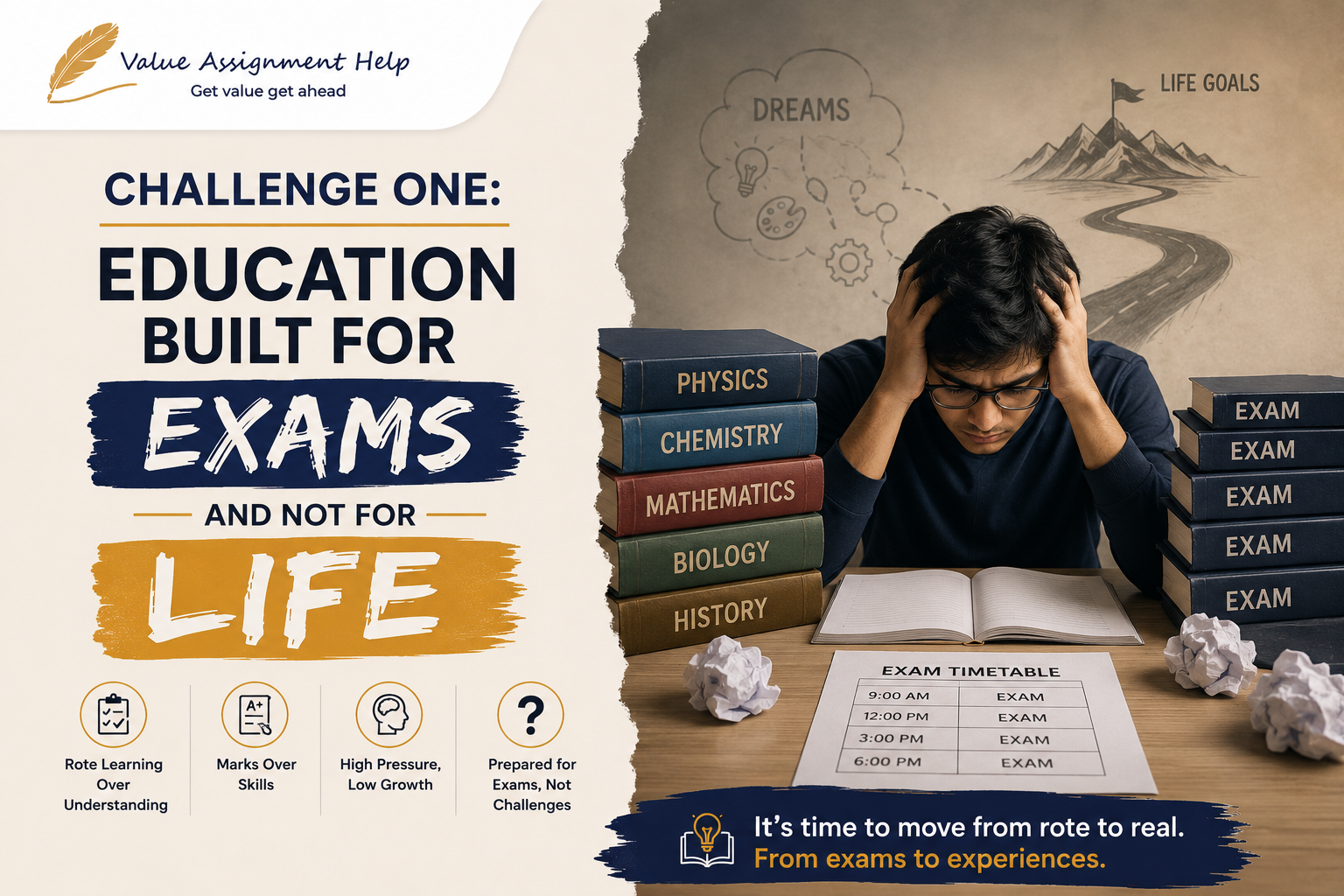 Let’s reflect on what schools have really taught us. We were made to think that our value as students was solely measured by a percentage. One scorecard guided our selections of subjects and streams. This single decision set the foundation for our educational goals and future career paths. For instance, scoring above 85 meant choosing commerce. Above that indicated a preference for science, and below that suggested arts. Anything beyond the 4-4 scorecard and exam syllabus was regarded as irrelevant, and our skills outside these boundaries were deemed insignificant. The decision to combine your interest and choice of work was seldom considered for the decision. Sometimes, students are just told to observe their peers and make a career choice or in some cases one friend follows another to decide on a course . The practice of consulting peers, neighbours, or elders before choosing a career isn't inherently bad but sometimes it's done without the child's consent or a scientific perspective.Career counselling is rare in India with only about 1 in 10 individuals opting for it.(https://indiaeducationdiary.in)
Having served the student community for years and being part of it as students ourselves, we firmly believe that the current approach needs revision, as the focus should not be solely on specialisation. Just as AI can handle multiple tasks at once we require a new emphasis on individuals who can effectively use technology and not get consumed by it. The National Education Policy (NEP) 2020 partially recognised this concern and proposed a more flexible learner-centred approach. Over the past six years, numerous schools across India have continued with the outdated system. However, the problem isn't only the
mismatch between the curriculum and real-world needs; it's also the reluctance to deviate from the traditional structure that has been building great minds- no doubt - but also contributing to an economy unable to employ its community. With the advent of AI the guard has to fall.
Patience is running out among our young generation as they consume everything quickly. The world where we used to process only a small amount of news a year now switches through information in seconds. As a result knowledge is in abundance and can take a backseat and the focus can shift to nurturing our young minds with basics- Underlying this issue is the more fundamental problem: a complete lack of moral education.A society driven by emotion and care will have collective responsibility instead of everyone moving individually.
We have a subject called Moral Science in our schools- but it has never been part of the final scorecardthat determines your future – Surprisingly you are not even required to give any test. Society guides
everyone with self-goals. Even schools, which teach us countless lessons do not necessarily prepare us to understand what it truly means to be a responsible citizen. This isn’t just about the Moral Education book offered as an optional subject; it’s about our genuine responsibilities towards those sitting next to you in class,plays with on the playground, shares the boundary walls with your house, and live under the country's Tricolour flag — encompassing spirit and culture.
Have you read Article 51 A of the Constitution? It enumerates 11 fundamental duties of every Indian citizen. Most of us cannot even name three. This is not our failure; it is our curriculum’s failure. Even though we were taught fundamental duties theoretically in our civic classroom, we still have a vacuum mind which takes these discussions a non-priority. But rights exist within a relationship; we have rights because others have agreed to honour them, and they expect the same from you. This is a social contract, which is the foundation of a functioning society, and it was actually never downloaded in the classroom with 100 % applicability.
Thus, the gap gets fermented in the young minds and subsequently passed on to society at large. We have a society now which is not ready to give an inch to anyone and fights for issues like parking and urinates in the open and thinks flouting rules as being cool.
In 2025, a study on civic behaviour in India revealed that young Indians are not inherently indifferent. Instead, they have not been provided with a proper framework for civic participation, unlike countries like Japan, Germany, and Singapore, which rank highly in youth civic engagement. These countries teach civic habits from primary school—how to maintain shared spaces, engage with community life, and recognise that public hospitals and parks are communal resources. Our curriculum condensed this broad domain into a single book without stressing the importance of the subject resulting in a generation that learned to compete for grades, positions, ranks, and jobs—but not how to collaborate. Society was conditioned to compete rather than cooperate. After 12 to 15 years in this system, students receive a degree and are directed towards the job market, marking the start of a second major issue.
Challenge 2: unemployment and employment without purpose:
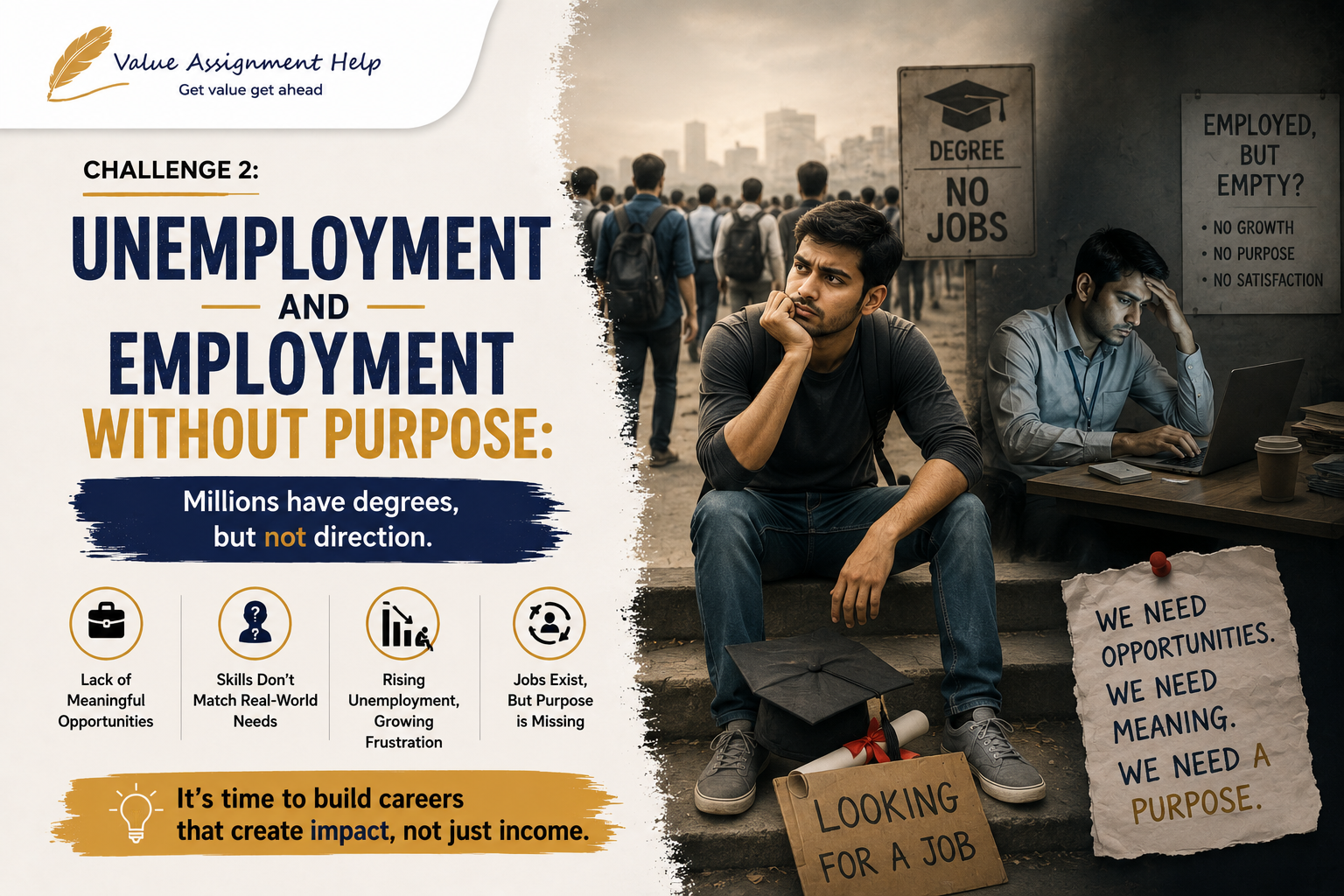
A universal statement resonating with the youth—unemployment and lack of jobs. Are we prepared to listen to what our youth have to say?
Jobs: The importance - 9.5 million searches per minute in Google globally and 30 billion searches in job portals for India.(Claude)
Truth for Jobs - ‘Jobs are there but talent is rare.’
Yes, we do have openings, but the right talent honing those skills is missing. We are sharing this opinion with great responsibility. The reality is so dark that even if we are operating our own job portal for hiring and placements, we are still struggling for basic hiring manpower- Tough days are yet to come.
With 16+ years of experience running a job portal www.jobsuraksha.in/jobsuraksha.com—and helping students and companies, we firmly believe that the problem is not a lack of jobs but a scarcity of skills.
With our skin at stake where we are struggling with an acute manpower shortage with the right fitment, we chose to move away from the old way of operating and focus on what our youth need — hands-on skill training and learning by doing, rather than just cramming for exams or preparing solely to get hired or start a business. Thats why we have chosen to tackle the core issue with Academic Mantra Skill Training Services, aiming to bridge the gap between expectations and reality.
A recent study conducted by ManpowerGroup in October 2025, involving around 40000 employers across 41 countries, reveals that over 70% of companies with between 10 and 5,000+ employees struggle to hire skilled workers. The global talent shortage is at 72%, with India among the top five nations, experiencing a shortage of 82%, just after Japan, Greece, Germany, and a few others. Interestingly, China has a talent shortage of 48% and is among the countries with the lowest shortages, along with Poland, Norway, Colombia, and the Czech Republic. . (2026 Global Talent Shortage Survey )
The more you study, the more likely you are to be without work. This is not an irony; this is a structural failure between what education produces and what Indian economy actually needs. In 2024, over 46,000 graduates and postgraduates applied for sanitation worker posts in Haryana. In Rajasthan, around 24.7 lakh people competed for the mere 50,000 openings for a peon. These are not people who had abandoned ambition, but these are the people who studied for years, who spent their family's savings on multiple coaching and fees, but later found that what they had been preparing for years has simply been closed. And this is not only the case in tier three or Tier 4 cities, but this is also the scenario of the entire country,nand every prestigious institution is part of the same group. The RTI inquiry found that two out of every five graduates across 23 IITs went unplaced in 2024.
The government job traps the security without contribution. When unemployment is scarce and uncertain, people seek safety, which is a rational response, and in India, the safest seeming destination for a young person who has studied for years is a government job- The Sarkari Naukri.
Millions of young Indians spend years, sometimes the most energetic years of their lives, preparing for government examinations, such as the UPSC, the SSC, state PCS, Railways, banking exams, and the coaching industry built around these exams is worth tens of thousands of crores. But there is a question beneath the aspiration that we rarely ask what happens after the job is secured.
A few days ago, the former CGI went viral on social media after making a controversial remark comparing unemployed youth to cockroaches. This ignited widespread debate. However, the main idea highlights a truth: we often jump to conclusions and share opinions regardless of the results. A population of 1.4 billion and with unemployment data rising and with affordable data in their palms, people continue scrolling during their free time, with some supporting and others opposing.
Why should this be seen as a moral judgment on any person? It is simply a structured observation. Why do highly educated people, considered among society's best minds, frequently struggle to invent new things? Why is the government sector often labelled as slow, lazy, or criticised for taking days or months to finish tasks? These are the same individuals who were expected to pass the toughest exams and earn
top scores.
The truth is, most of the time, we focus on preparing just for the entry rather than the job itself. Landing the job feels like the goal, and what happens afterward—whether useful work is performed or people are
served—becomes less important.
There's nothing wrong with seeking a secure job; everyone needs job security, which is a legitimate necessity. The tragedy is that an entire generation’s productive energy is being directed toward competinfor positions rather than focusing on creating meaningful projects. Government institutions, hospitals, schools, and offices are only as effective as the people who show up daily and genuinely take
responsibility for their work. When the culture is driven by the mentality of just maintaining one's position and staying put, the entire institution suffers.
This connects directly to the education issue: we weren't taught that work is a means to contribute to society. Instead, we learned that work primarily offers personal security. Both viewpoints can be valid, but emphasizing only one results in the current scenario: educated people who are occasionally unemployed but not genuinely engaged.
Economists consistently cite education and healthcare as the two fundamental pillars that influence a nation's long-term stability. This is not because they are the most immediately profitable sectors, but because they are essential for society to benchmark itself for a growing future with a sound population.
The Indian education system is not failing solely due to a lack of investment; it is also because it has lost focus on the true purpose of education. Although NEP 2020 introduces reforms, their implementation remains to be seen. India’s unemployment crisis is not decreasing merely because there are too few jobs; part of the issue is that society values holding a job more than the quality of the contribution it entails.
The civic gap in our education—where no one teaches us to feel responsible for society—can be
addressed immediately, without waiting for curriculum reform. We need to create a society that cares, especially with the incoming generation. Using AI, they may lack basic manners, as interacting with machines requires no emotion. Just as a doctor loses empathy for humans when trained to operate on objects, our future depends on how well we train the new generation in a basic civic sense, since emotions are all we have to counter AI.
Disclaimer: all content and intellectual property remain the exclusive property of value Assignment Help









No Comments